
Best time to visit · Season guide
June — August · Coast season
Summer in Morocco.
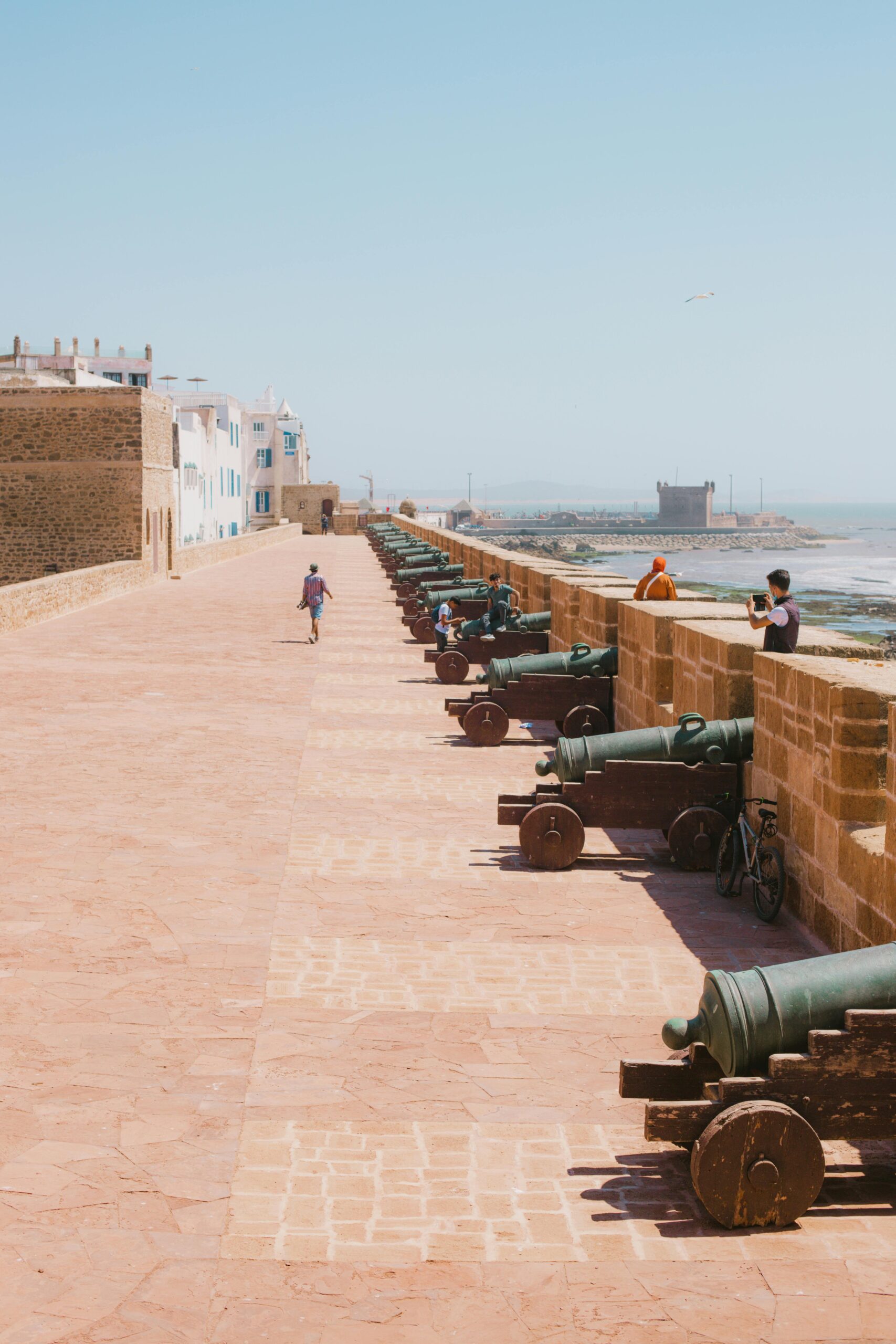
Marrakech hits 38°C and the whole country migrates west. Essaouira's wind, surf villages, late-night rooftop dinners, the Gnaoua festival, and Asilah's walls being painted by visiting artists every August.
A note from Izem. I grew up summering in Essaouira. Marrakech families do the same thing — we all go to the coast. If you're a tourist in Marrakech in July, you've come at the wrong time.
Summer in Morocco splits the country in two. Inland — Marrakech, Fès, the desert — bakes. Marrakech regularly hits 38°C by 2pm, the medina becomes unwalkable between noon and 5pm, and locals retreat behind shuttered windows until evening. Meanwhile the Atlantic coast does something miraculous: the same Atlantic wind that makes Essaouira annoying in winter becomes the country's saviour in July. Coastal temperatures stay between 20 and 25°C all summer. Everyone with means moves west.
This is the rhythm to plan around. Mornings inland, afternoons on the coast. Or skip inland entirely and base yourself in Essaouira, Taghazout, Asilah or Imsouane — the surf villages, the Gnaoua festival, the painted walls, the late-night fish dinners at the port. The Atlas is the third option: at 1,700–2,500 metres, Imlil and the high valleys are perfectly cool, the wildflowers from spring linger, and the trekking is at its best with no snow anywhere.
The two places to genuinely avoid: the Sahara any time in July or August (it routinely exceeds 45°C in the dunes — not "hot," dangerous) and Marrakech as your sole base. If you only have a week and it's August, fly into Marrakech and immediately bus to Essaouira. Don't burn your trip in the Red City when the country is asking you to go west.
The Moroccan summer is geographic. Stay inland and suffer; go to the coast and understand the season.Izem · from the field
The weather
Region by region.
Summer is the season Morocco's geography matters most — 600 kilometres east-to-west can be the difference between 25°C and 45°C on the same afternoon.
Marrakech & the south plains The Red City
22–38°CHot. Sometimes very hot. The medina runs on a siesta schedule — shops shut from 1pm to 5pm, restaurants reopen at 8pm, locals sleep through the afternoon. Plan mornings (7–11am) and evenings (after 7pm) only. Riad pools become non-negotiable. Hammams turn into oases. Riad prices drop 20–30% from spring.
Atlantic coast Essaouira, Taghazout, Imsouane
18–25°CThe reason summer exists. Atlantic wind keeps everywhere from Tangier to Agadir at 20–25°C through August. Essaouira hosts the Gnaoua festival in late June — the single best music event in North Africa. Taghazout fills with surfers (small swells in summer, big in winter). Imsouane is the quiet alternative. Book everywhere ahead.
High Atlas & Toubkal Imlil & the peaks
12–25°CThe mountain escape locals use. Imlil at 1,700m stays cool day and night. Toubkal is at its easiest in July and August — no snow above the refuge, dry trails, long daylight hours. M'Goun trekking is fully open. Berber villages are at their busiest with summer pasture activity. Book Imlil hotels 4–6 weeks ahead.
Sahara & the south-east Merzouga, Zagora, Dades
25–48°CNo. The Sahara in July and August is not "very hot" — it's a medical hazard. Dune surfaces hit 60°C, the air at 2pm hits 45°C, camel tours run skeleton schedules at dawn and dusk only, and most camps close for the season. Save the Sahara for September through April. Dades and Skoura still work in early morning visits with air conditioning.
Northern coast Tangier, Asilah, Tetouan
18–28°CThe other summer answer. Tangier becomes the city it's meant to be in July — rooftop dinners, Strait of Gibraltar views, Petit Socco crowds until midnight. Asilah's Arts Festival in August brings artists from around the world to paint new murals on the medina walls. Tetouan is mellow and culturally rich. Mediterranean breeze every afternoon.
Fès & the interior north The medieval medina
18–36°CHot during the day, cool at night. The medina is shaded enough to be walkable until midday and after 5pm. The tanneries smell more than usual in summer heat — pack a sprig of mint (your guide will offer one). Riads with courtyards stay cool naturally; air-conditioned ones are increasingly common. Sefrou's Cherry Festival in early June is the warm-up.
What's happening
Summer's moveable feast.
Six things that only happen between June and August — the festivals, the surf, the rooftop rhythm that locals plan their year around.
Gnaoua World Music Festival.
Late June, Essaouira. Three nights, four stages, free. Gnaoua master musicians (the descendants of West African slaves who created the genre) fuse with jazz, blues, electronic and rock acts from around the world. The whole town becomes one open-air venue.
Late June · Essaouira
Atlantic surf villages.
Taghazout, Tamraght, Imsouane — the surf coast wakes up. Smaller swells than winter but warmer water and longer days. Beginner schools run all summer (300–400 MAD for a 2-hour group lesson). Yoga + surf retreats fill up fast.
All summer · Taghazout, Imsouane
Asilah Arts Festival.
Three weeks in August. International artists arrive in the white-walled town on the Atlantic and repaint the medina — new murals every year, replacing the previous ones. Concerts, poetry readings, food stalls. The town's identity in microcosm.
August · Asilah
Late rooftop dinners.
Marrakech, Tangier, Fès, Essaouira — the rooftop is the summer dining room. Riads serve dinner from 8:30pm; restaurants stay open until 1am. The stars, the call to prayer, a long mint tea after the meal. The most local thing summer offers.
All summer · Every city
The midday siesta rhythm.
From 1pm to 5pm inland Morocco shuts. Shops close, restaurants empty, traffic thins. Locals retreat to dark rooms or shaded patios. Travellers who fight this rhythm have miserable afternoons. Travellers who follow it have the best evenings of their trip.
All summer · Inland
Peak European tourism.
July and August are when the rest of Europe takes its annual leave — flights from France, Spain, UK, Germany triple in price. Riads in coastal towns sell out. Group tours run convoys. Book everything 8+ weeks ahead, especially if you want Essaouira during Gnaoua.
Jul — Aug · Especially coast
What to bring
The summer packing list.
Light, breathable, sun-protective. The mistake most travellers make: not enough cotton, not enough sun cover.
Must bring
- Loose cotton & linen (long sleeves)
- A wide-brim sunhat
- SPF 50 sunscreen
- Swimsuit & quick-dry towel
- Sandals + closed walking shoes
- Sunglasses (polarised)
- Refillable water bottle (1L+)
Helpful to have
- Light scarf for shoulders & medinas
- Hiking shoes if going to the Atlas
- Surf wetsuit shorty (cooler water)
- Plug adapter (Type C/E)
- Electrolyte tablets for the heat
- A light cardigan for AC indoors
Where to go — and not
Summer do's & don'ts.
After three summers of doing this professionally, this is what we'd recommend — and where the heat will punish you.
Do
- The Atlantic coast as your base Essaouira, Taghazout, Imsouane, Asilah. Cool sea breezes, late-night dining, blue boats, surfers, festivals. Stay 4–6 nights minimum; day-trip inland from there.
- Gnaoua World Music Festival Late June in Essaouira. Free stages, paid headliners. Book your riad in February or accept hostel dorms. The single best music event in North Africa.
- The High Atlas at altitude Imlil and the M'Goun massif are at their peak. Cool nights, wildflower meadows, long trekking days. The Toubkal summit is at its easiest — no snow, no crampons.
- Marrakech only at dawn and dusk Wake up at 6am to walk the medina, breakfast on a rooftop, retreat to a pool from noon, re-emerge at 7pm. Done this way Marrakech still works. Done normally, it punishes.
- Asilah Arts Festival in August Three weeks of murals being painted, concerts at sunset, a town transformed into a gallery. Pair with Tangier for a 6-day northern coast trip.
Skip
- The Sahara in July or August Not negotiable. The dunes exceed 45°C in the afternoon, most camps close, camels are barely operational. Save Merzouga and Zagora for September through April.
- Marrakech midday medina walks Between 1pm and 5pm the medina is essentially closed and the sun is genuinely dangerous on cobbles that hold heat. Treat midday as nap time. Locals do.
- Inland day-trips at noon Ait Ben Haddou, Ouzoud Falls, Setti Fatma waterfalls — all in the Atlas foothills, all 30+°C by lunchtime. Go at 7am or 5pm, not 11am. The 7am bus is half-empty.
- Last-minute Essaouira during Gnaoua Riads triple their rates the week before the festival and sell out 4–8 weeks before. Either commit by February or stay 30km away in Sidi Kaouki and bus in.
- Forgetting that everything closes 1–5pm Banks, post offices, many cafés, most shops — closed. Plan your errands for 9–noon or 5–7pm. This is the easiest summer mistake to fix.
Things we learned the hard way
Notes from three summers.
Small, specific, hard-won. The kind of detail a guidebook will never tell you.
— Asmoon
The Gnaoua free-stage secret.
Most travellers buy passes for the paid stages at Gnaoua. The locals know the secret: the free Place Moulay Hassan stage and the Bab Doukkala stage have the most authentic gnaoua acts, often the maâlems (masters) playing for their own community without fusion crossovers. Get there by 8pm to secure a spot on the wall. Bring a bottle of water and a sweater — nights cool down hard.
— Amghar
Imsouane over Taghazout.
Taghazout in July is a backpacker city — full of Europeans, dorm beds at premium prices, party hostels. Imsouane, 1.5 hours north, is what Taghazout was ten years ago: a tiny fishing village with the longest right-hand wave in Africa, a couple of quiet hostels, and grilled fish at the port. Take the bus to Tamri then a grand taxi for 50 MAD.
— Izem
The Imlil mid-summer trick.
If you're in Marrakech in July and want one cool night: do an evening grand taxi to Imlil, 90 minutes from Marrakech. Sleep at Dar Imlil or Riad Atlas Toubkal (450–700 MAD). 12°C cooler than the city. Wake at 6am, do a half-day hike to Sidi Chamharouch or Tizi Mzik, back in Marrakech by lunch. We do this several times each summer.
— Asmoon
The water rule.
Two litres a day, minimum. Locals drink less but they're adapted. Tourists who don't carry water in summer are the ones who end up in hospitals. Refill at every café — many will fill your bottle for free if you bought a coffee. Avoid plastic bottles when you can: ask for filtered or tap with a "boutia s'naka khawia" (an empty bottle), then refill yourself.