
Traveller's guide · Language & local codes
9 min · 40 phrases that open doors · By Asmoon
The Darija primer.
A pocket of words and phrases that open doors. Shukran, bsslama, l'aafak, hna, mzyan. The forty expressions that change how a shopkeeper sees you, the small grammar that earns you a stool at a café.
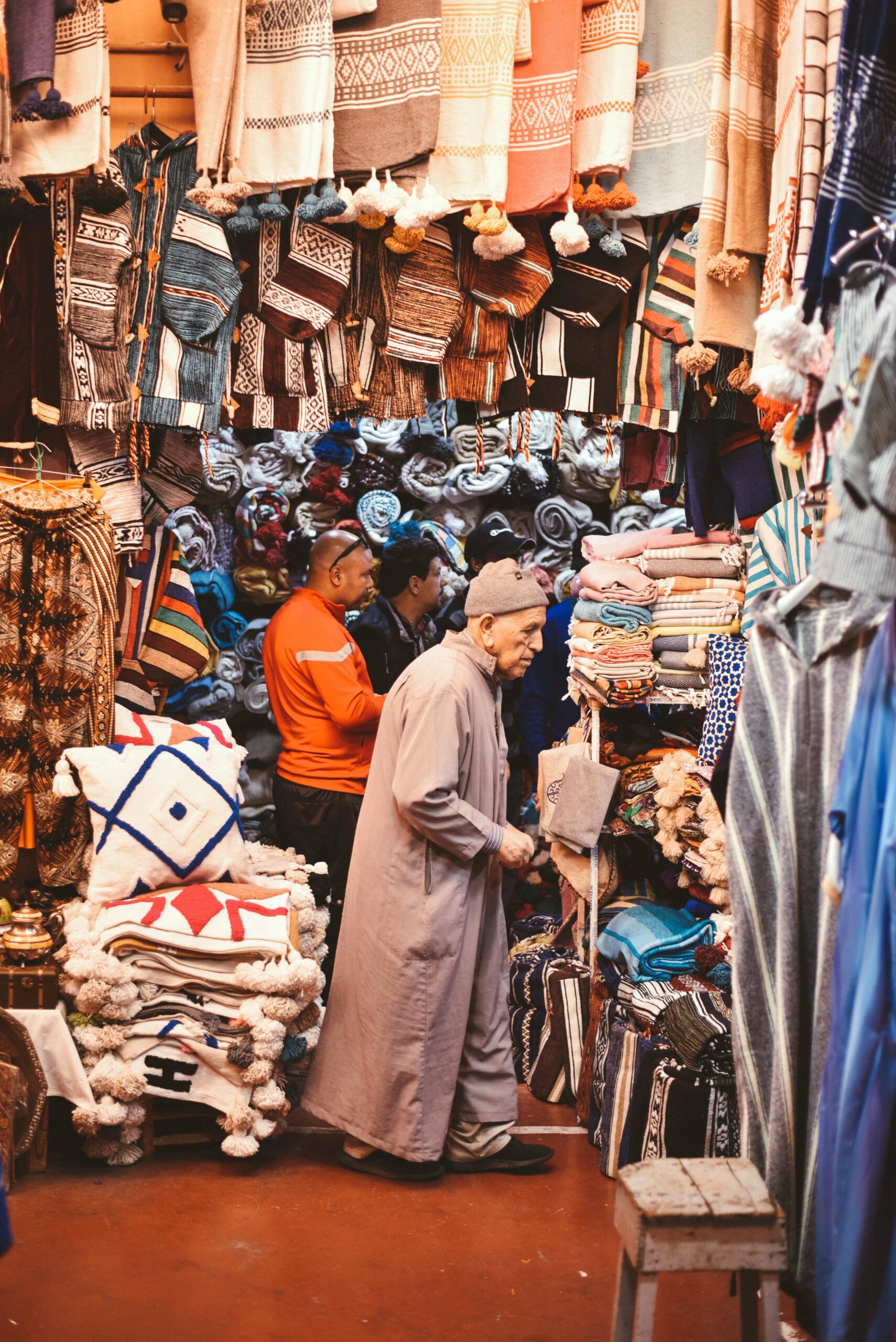
A note from Asmoon. I was raised speaking Darija, French, and English — in that order at home. The look on a shopkeeper's face when a foreigner says one Darija word correctly is the most consistent reward I've seen in this country.
Darija is what Moroccans actually speak. Not Modern Standard Arabic (which is for newspapers, mosques, and television), and not Berber-Tamazight (which is for the Atlas villages and the south). Darija is the street language: Arabic with a heavy splash of Berber, French, and Spanish. It's nobody's textbook language — you'll find no Duolingo course for it — and that's exactly why three correctly-spoken words earn you so much grace.
The trick isn't fluency. It's the right five or ten words used at the right moment. When you say "shukran bzaf" (thank you very much) to a hammam attendant, she remembers you. When you greet a shopkeeper with "sbah l'kheer" (good morning) before asking the price, the price drops. When you ask for "qhwa nuss nuss" (half-coffee, half-milk) instead of pointing at the menu, the waiter brings you the proper version with a small biscuit on the side.
This guide is the forty phrases I'd hand a friend on day one. Plus the three sounds you'll have to actually practise, the body language that goes with the words, and the few things you genuinely should never say. An afternoon of memorising this changes your whole trip.
Three correctly-spoken words in Darija will earn you more grace than three weeks of textbook French.Asmoon · from the field
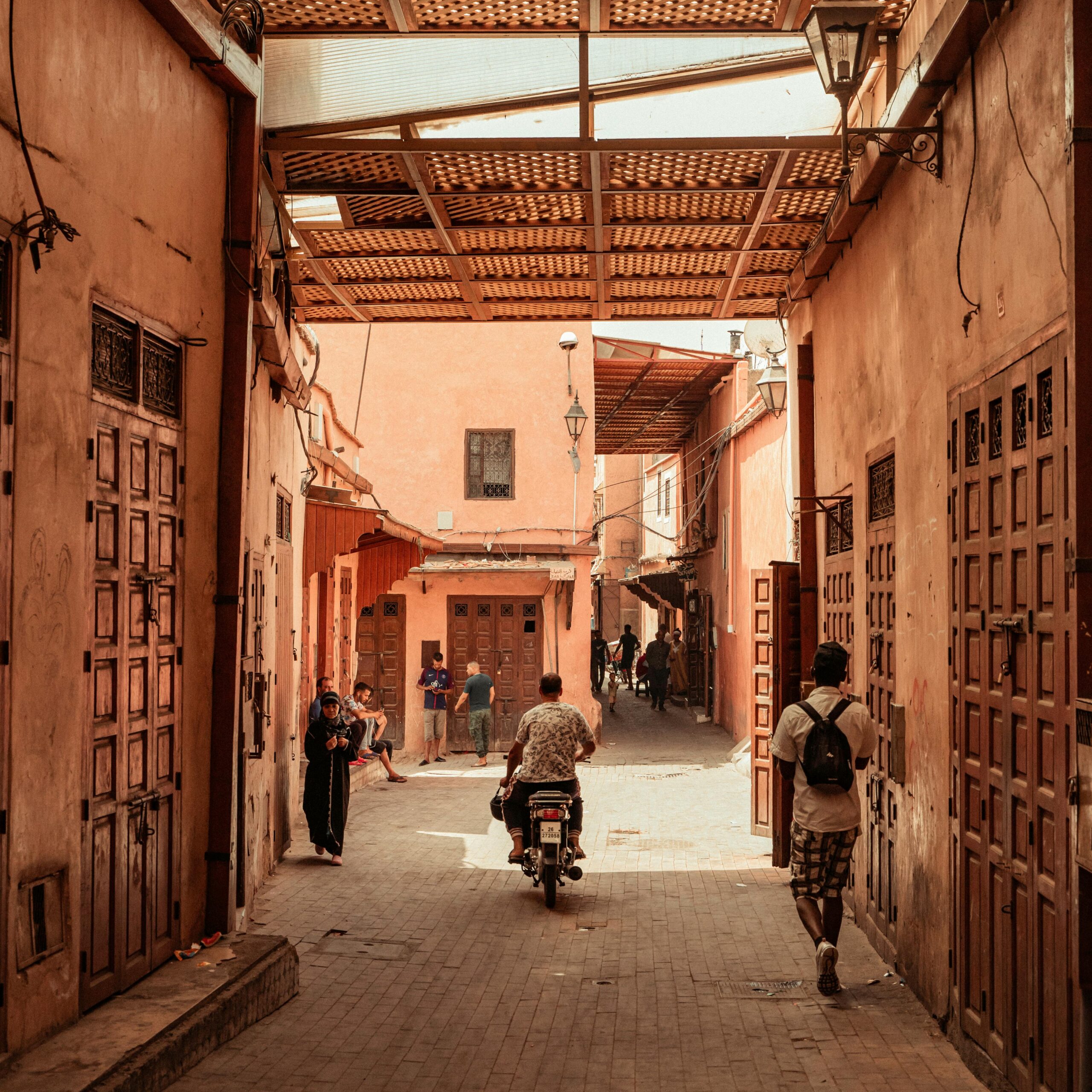
Write the three magic words on the inside of your hand on day one. By day three, you won't need to look.
Before the phrases — the sounds
The three Darija sounds Western tongues don't have.
If you only practise three sounds before you arrive, these are the ones. None are hard once you've heard them spoken — but mispronounced, they make polite phrases unrecognisable.
The throat sounds, demystified
A hard breathy "h" from the back of the throat — like fogging up a window. Appears in shukran, hshouma, hamdullah. Listen for the friction at the throat, not the chest.
A glottal stop with a slight throat constriction, like a swallowed "a". Appears in l'aafak (please), 'ashra (ten). The mark looks like a backwards apostrophe in transliterations.
A soft rolled "r" from the back of the throat — like a French "r" gargled gently. Appears in maghrib (west / sunset), ghir (only). Closer to a soft growl than a sharp consonant.
A deep "k" from the very back of the throat, like swallowing the consonant. The difference between qalbi (my heart) and kalbi (my dog) lives here. Make Moroccans laugh by getting it wrong; charm them by getting it right.
If you only learn three
The magic three.
Forget the other thirty-seven for a moment. These three are the words that change how every interaction goes. A Moroccan friend will tell you the same.
Shukran
SHOO-kran
Thank you
Used after every transaction. Pair with "bzaf" (a lot) for emphasis. A small nod and right hand to the heart finishes it perfectly.
Aafak
l-AH-fak
Please
Goes at the end of any request. "Atay aafak" — tea please. Or alone, used like "excuse me" to get a waiter's attention.
Smahli
SMAH-lee
Sorry / excuse me
For passing through crowds, accidentally bumping someone, declining politely. "Smahli" + a small palm-up gesture defuses almost any awkward moment.
The forty phrases
By the moment you'll need them.
Memorise these in groups, not all at once. Pick the three or four you'll use today, leave the rest for tomorrow. Apostrophes (') mark slight pauses or throat sounds.
Greetings & farewells
Salam
SAH-lam
Hi / peace
The universal short greeting. Works any time of day, any setting.
Salam alaikum
SAH-lam ah-LIE-kum
Peace be upon you
The formal version. Used entering shops, riads, family homes. Reply: "wa alaikum salam".
Sbah l'kheer
SS-bah l-KAYR
Good morning
Up to about 11am. The most-used greeting in cafés before lunch.
Msa l'kheer
MM-sah l-KAYR
Good evening
From mid-afternoon onward. Greeting a shopkeeper at 5pm.
Labas?
la-BAS
How are you? (lit: no harm?)
The universal "how's it going". Reply: "hamdullah, labas" (thank god, good).
Bsslama
bis-SLA-ma
Goodbye (lit: with peace)
Leaving any setting. Pair with a hand-to-heart for warmth.
Yes, no, OK — and modifiers
Iyyeh
EE-yeh
Yes
More common in Darija than na'am (formal Arabic yes). A short nod with it works.
La
LAH
No
A flat tone — not the rising "la?" of French. Pair with palm up.
Wakha
WAH-kha
OK / fine / agreed
Closes any transaction. Used like "sounds good". The most-heard word in Morocco after Inshallah.
Mzyan
m-ZYAN
Good / nice
Compliment to food, weather, photos, or trips. "Mzyan bzaf" = very good.
Bzaf
b-ZEF
A lot / very
The intensifier. "Shukran bzaf" (thank you very much), "mzyan bzaf".
Shwiya
SHWEE-ya
A little
"A little" of anything. "Shwiya sukar" — a little sugar. "Shwiya b shwiya" = slowly.
In a café or restaurant
Atay bi na'na'
ah-TIE bee NAH-nah
Mint tea
The national order. Atay alone also works; bi na'na' = with mint.
Qhwa nuss nuss
QHWA noose-noose
Half coffee, half milk
The Moroccan version of a latte. Cheaper than the spelt-out version, marks you as someone who knows.
Ma
MAH
Water
For bottled, specify "Sidi Ali" (still) or "Oulmès" (sparkling). For tap: "ma del robine".
Bla sukar
blah SOO-kar
Without sugar
Crucial. Moroccan tea defaults to extremely sweet — this saves your teeth.
L'hisab aafak
l-hee-SAB l-AH-fak
The bill, please
The universal restaurant exit phrase. A small writing-in-the-air gesture works too.
Bnin bzaf
b-NEEN b-ZEF
Delicious
Said to a cook directly. "Bnin" alone = tasty. Earns a refill on the bread basket.
Shba'at
SH-bah-aht
I'm full
When a host keeps offering more food. Pair with a hand to the chest.
In the souk — haggling
Bsh-hal?
b-SH-hal
How much?
Opens the haggling dance. Always ask, never assume. The first quoted price is the starting offer.
Ghali bzaf
GHAH-lee b-ZEF
Too expensive
The polite first counter. Smile when you say it. The shopkeeper will lower; counter back with a number 30–50% lower than theirs.
Akhir taman
AH-kheer ta-MAN
Final price?
Signals the end of the bargaining round. Used after 2–3 counter-offers. They'll usually give you a real number.
Endek shi...?
EN-dek shee
Do you have...?
Followed by what you want. "Endek shi argan?" — do you have argan oil?
Safi
SAH-fee
Enough / that's it
Closes any transaction. Used after the haggling ends, the food is sufficient, the conversation is done.
Mashi mushkil
MA-shee moosh-KEEL
No problem
Polite refusal. "Mashi mushkil, shukran" = no problem, thanks — for declining a guide, a hustler, an offer.
In a taxi & on the road
Avec compteur
a-vek con-TER
With the meter, please
French — but it's the universal taxi phrase here. Drivers respond to it instantly. Petit taxis are metered by law.
Sir nichan
seer nee-SHAN
Go straight
For directing a taxi or asking for directions. Point ahead while saying it.
Yemen
YEH-men
Right (direction)
Yes, like the country. Said with a small right-hand gesture.
Yssar
yi-SAR
Left (direction)
Pair with a left-hand gesture. The driver will figure it out.
Wakkef
WAK-kef
Stop here
When you've reached your destination. Pair with "hna" (here) for clarity.
Fin l'pharmacie?
feen far-ma-SEE
Where's the pharmacy?
"Fin" = where. Swap in l'hôtel, l'gare (station), la poste, etc.
The cultural reflexes
Inshallah
in-SHAH-lah
God willing
After any future statement — "see you tomorrow, inshallah". Used by everyone, religious or not. Cultural rather than purely religious.
Hamdullah
HAM-doo-lah
Praise to god / I'm well
The universal response to "labas?" or any good news. Said with a hand to the heart for sincerity.
Bismillah
bis-MIL-lah
In the name of god
Said before eating, starting a meal, or beginning anything significant. Both religious and conversational.
Bsah-ha
b-SAH-ha
To your health / enjoy
Said when someone is eating, drinking, or has just bought new clothes. The all-purpose blessing.
Hshouma
HSH-oo-ma
Shame on you
The nuclear option. Said loudly stops harassment in five seconds — other Moroccans will side with you immediately.
The four numbers that matter
'Ashra
AH-shra
10 (dirhams)
The price of a coffee, a juice, a bus ride. "'Ashra dirham" = 10 MAD.
Khamseen
kham-SEEN
50
The most-used haggling number. A meal, a hammam, a small souvenir — all hover around 50 MAD.
Mia
MEE-ah
100
The major-decision price point. Riads, taxis from the airport, tagines all live at multiples of 100 MAD.
Alf
ALF
1,000
Big-ticket items — a rug, a leather bag, a hotel splurge. Always negotiate when this number comes up.
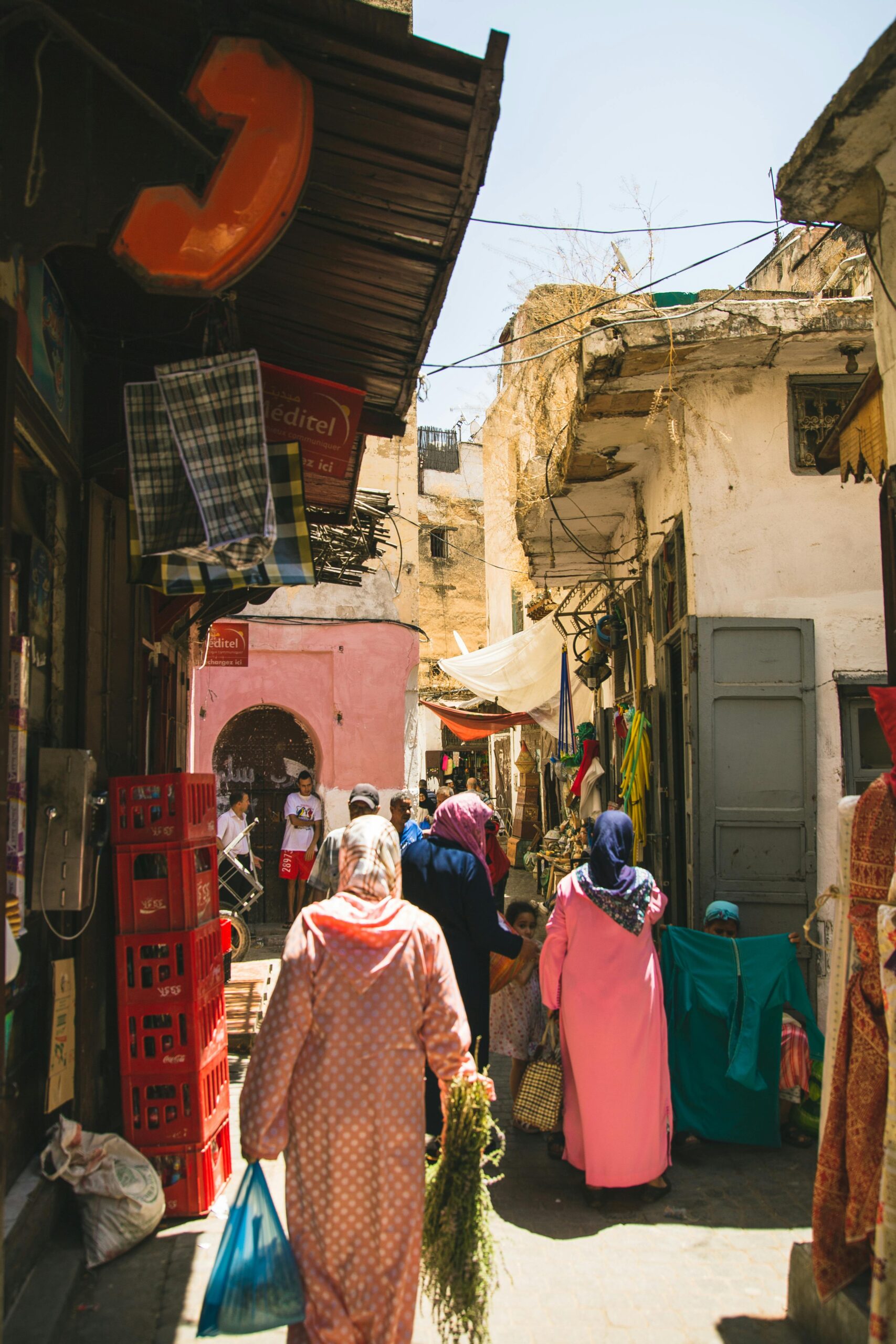
The hand to the heart after a handshake. The single most warming gesture in Moroccan culture.
Beyond the words
The gestures — and the lines not to cross.
Half of Darija is body language. The other half is knowing the handful of topics that close doors instead of opening them.
The body-language codes
- Hand to the heart after handshake The universal gesture of warmth in Morocco. Shake hands, then briefly touch your right palm to your chest. Says "sincerely glad to meet you" without a single word.
- Right hand only — for everything Eating, giving money, taking change, greeting. The left hand is considered unclean. Even left-handers eat with the right.
- Hand wave = "come here", not goodbye Palm down, fingers brushing toward you. The Western palm-up "come here" gesture is rude here. Wave goodbye is the standard side-to-side.
- Hand under the chin = "later" Flicked outward from under the chin. Means "I'll see you later" or "don't worry about it". The most useful informal gesture you'll learn.
- Pinched fingers upward = "wait a moment" Fingers gathered at the tips, hand raised slightly. Means "hold on, let me finish". Universal in Morocco; rude in most other cultures.
- Open palm to the chest = "no, thank you" A small dignified refusal. Used to decline food, drinks, offers without giving offence. Pair with a smile.
The conversational landmines
- Don't ask about the king The monarchy is genuinely off-limits. Even positive comments can put a Moroccan in an awkward spot. Skip the topic entirely.
- Don't ask if someone is Berber or Arab A sensitive identity question with political weight. If it matters, the person will tell you themselves. Otherwise leave it.
- Don't use Egyptian or Lebanese Arabic phrases Egyptian dramas are popular but using their phrases here reads as patronising. Stick to Darija or simple French.
- Don't say "thank you" three times in a row Western over-thanking reads as anxious. One shukran, sometimes with bzaf, is the norm. Multiple thanks make Moroccans feel you're insincere.
- Don't ask "is this Halal?" in a restaurant In Morocco, almost everything is Halal by default — asking the question implies suspicion. If you have a specific dietary restriction (pork, alcohol), state it; don't probe.
- Don't bring up Algeria, Western Sahara, or France colonisation All loaded topics with strong opinions. Better to let Moroccans raise them if they want to discuss; foreigners initiating them rarely lands well.
Things we learned the hard way
Notes from the team.
The specific Darija moments that taught us something. Lived, small, hard-won.
— Asmoon
The 10 MAD discount you didn't earn.
An Italian friend of mine asked for "Atay bi na'na' aafak" at a Marrakech café in May. The waiter brought her tea, the small biscuit, AND a free orange juice. The bill: 15 MAD, when the menu said 25. She didn't even ask. The right four words at the right time triggered the local-price discount. That's not unusual — it happens to her every other day on her trips here. The pattern is real.
— Amghar
The taxi-driver test.
Get in any petit taxi in Morocco. Before saying your destination, say "sbah l'kheer, ssidi" (good morning, sir). Watch the driver's face soften half a degree. Then state your destination. The whole ride changes. He asks where you're from, recommends a fish restaurant near your hotel, refuses your tip. The greeting is the entire test. Skip it — same driver, different ride.
— Izem
When the haggling gets stuck.
A souk negotiation has reached the point where the shopkeeper won't move and neither will you. Say "safi, shukran, bsslama" — enough, thank you, goodbye — and start walking. Nine times out of ten you'll be called back within ten steps with a new lower price. The walk-away is the most powerful Darija sentence in any souk. Use it sparingly though; do it once per shop, not as a tactic.
— Asmoon
The hostel-rooftop Darija class.
Every backpacker hostel in Marrakech (Riad Dia, Equity Point, Atlas Equity) hosts a free informal Darija "lesson" on the rooftop most weeks — usually a 30-minute session run by the staff over mint tea. It's where I send every solo traveller on their first night. You leave with the 10 phrases that matter, a few new friends, and an actual ear for the throat sounds. Free. Ask at reception.