
Traveller's guide · Food & the kitchens
14 min · The plates that tell the story · By Izem
The plates that tell the country's story.
Tangia, pastilla, harira, mechoui, msemen with amlou. What's worth queuing for, where the locals actually eat, and the kitchens we'd send our mothers to.
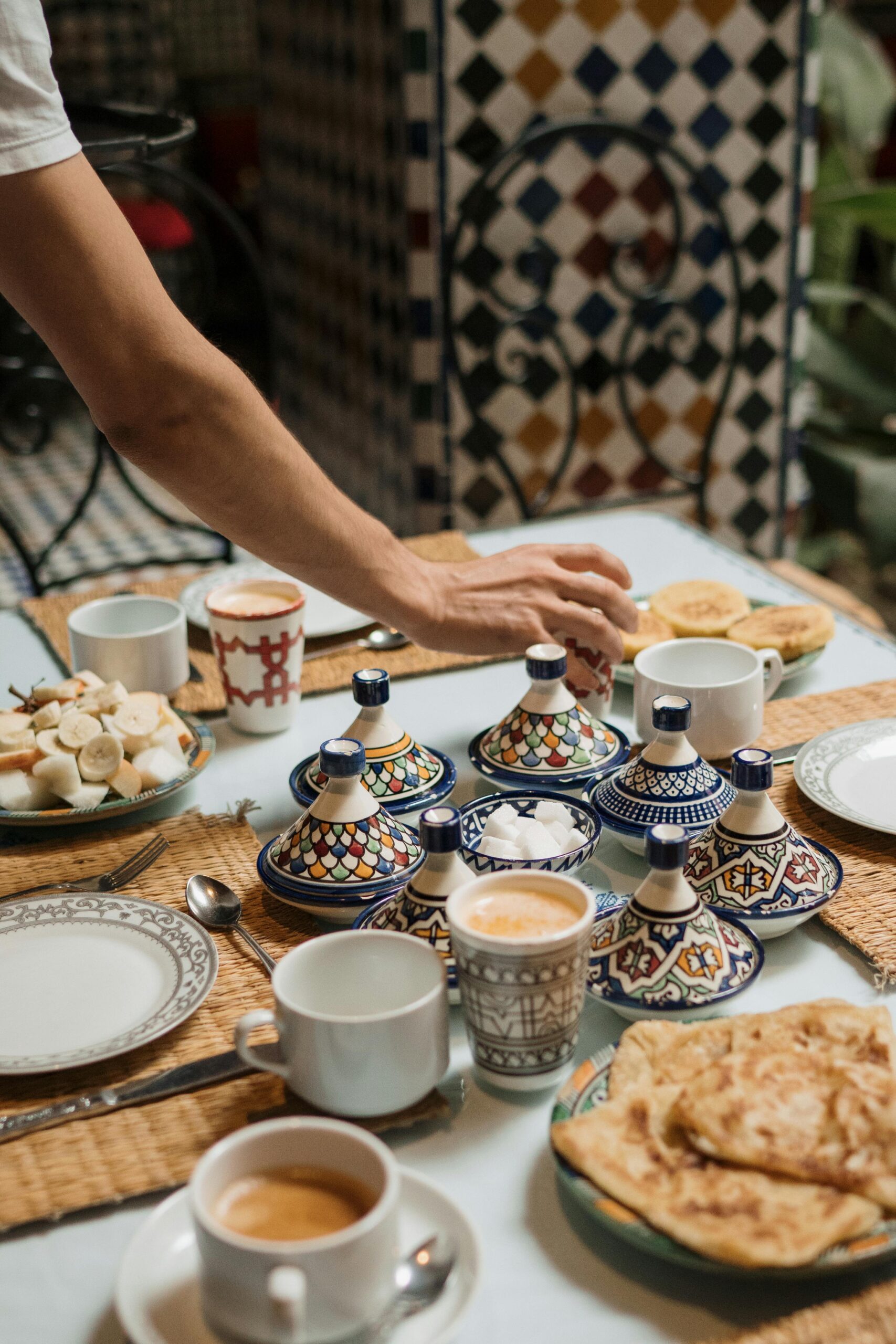
A note from Izem. I learned to cook tangia from my uncle's neighbour, who learned from a hammam stoker, who learned from his grandfather. None of these people wrote a recipe down.
Moroccan food is the country at its most honest. There is no "Moroccan restaurant" in the way there is a French or Italian one — the food you'll eat in a Marrakech riad is closer to what the family eats at home than any restaurant abroad ever gets. The recipes are passed by hand. The proportions are guessed. Bsahha, the universal "enjoy your meal," literally means "to your health" — not a politeness, a wish.
Five dishes carry the story of the country. Tangia is Marrakech's bachelor stew, cooked overnight in clay urns buried in the hammam embers. Pastilla is the Fès dish of dynasties — sweet, savoury, ridiculously labour-intensive, made today only by households who still know how. Harira is the Ramadan soup, eaten with dates to break the day's fast. Mechoui is the Berber celebration — a whole lamb pit-roasted underground for six hours. And msemen with amlou is the Atlas breakfast that no Western breakfast has ever come close to.
This is the field guide to those five dishes — what they are, where to find them at their best (not their most famous), what they cost, what to avoid. Plus the Friday couscous ritual, the street-stall essentials, and the kitchens we'd send our mothers to. If you eat one good meal a day on the right plate, you'll understand more about Morocco than from any museum.
If you've never eaten with three generations of a Moroccan family on a Friday afternoon, you haven't been to Morocco yet.Izem · from the field
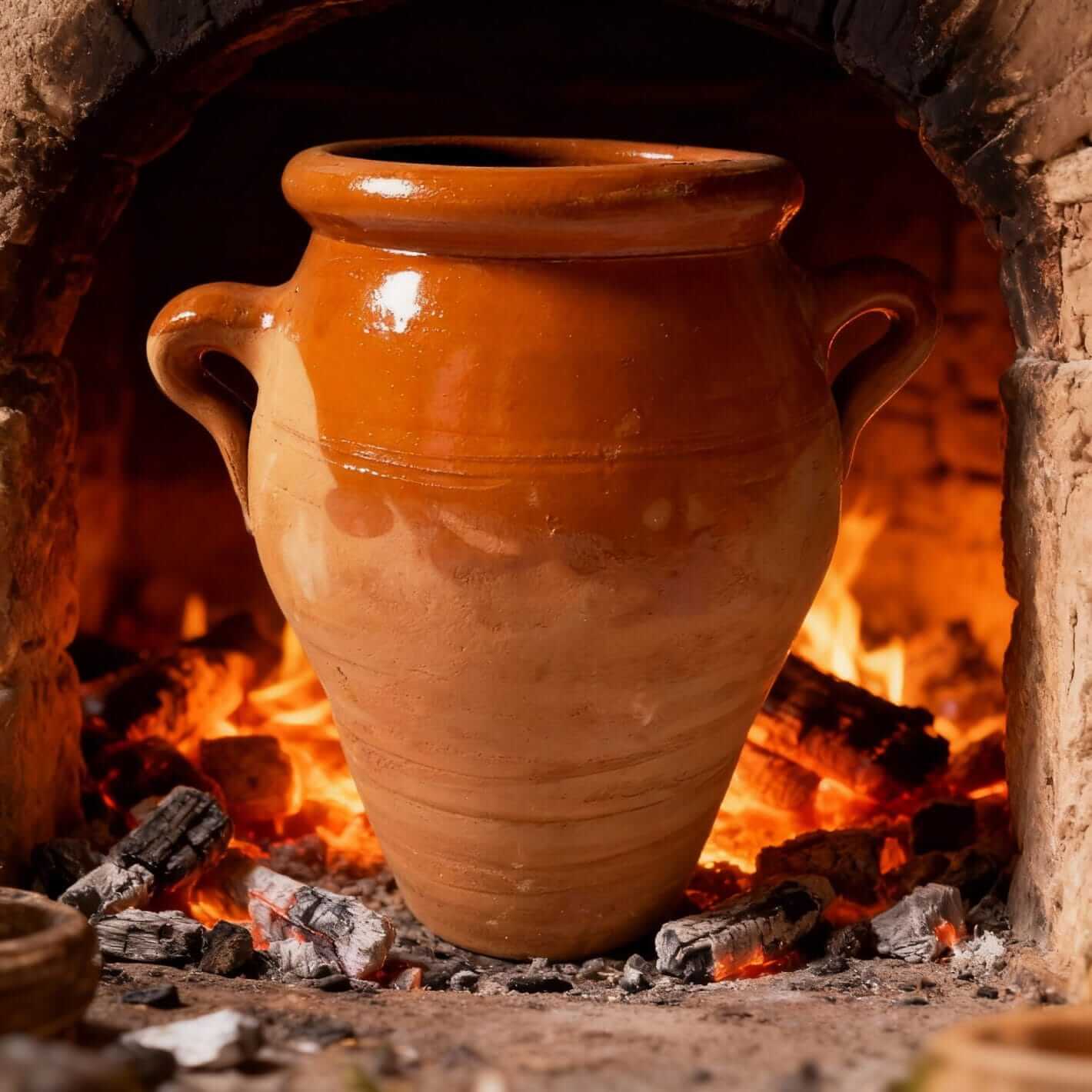
The clay urn is the dish's name — "tangia" — and the stoker's name carries the cost.
The five plates
The dishes that tell the country's story.
Five iconic plates that reveal more about Morocco than any guidebook chapter. Each with its origin, its true location, and the price you should pay for the real version.
Tangia
TAN-jee-ah
Marrakech's signature dish, named after the clay urn it cooks in. Lamb or beef shanks, preserved lemon, garlic, cumin, saffron, smen (aged butter) — sealed in the urn with a paper lid and buried for 5–6 hours in the ashes of the local hammam furnace. Originally a bachelors' dish — men brought their urns to the hammam stoker on the way to work and picked them up tender on the way home.
The meat falls off the bone, the broth is dense with collagen, and the whole thing is eaten with bread, not cutlery. You can't make this dish faster. Anyone offering you a 30-minute tangia is offering you a tagine. The two are not the same.
Pastilla
pa-STEE-yah
A dish of dynasties — sweet-savoury phyllo pie, traditionally made with pigeon (now usually chicken), saffron, eggs scrambled with herbs, and crushed almonds. Dusted on top with cinnamon and powdered sugar in concentric circles. The combination confuses Westerners on first bite, then converts them on second. It's a Fès recipe by origin, perfected by Andalusian refugees in the 15th century.
Real pastilla takes a full afternoon to prepare. A good one has 6–8 phyllo layers, glossy from the almond paste. A bad one is freezer-bought and reheated — you can tell because the sugar is in straight lines instead of swirls. Order at lunch, not dinner — pastilla cooks are home with their families by 8pm.
Harira
hah-REE-rah
The Moroccan soup. Tomato base, chickpeas, lentils, lamb or beef in small pieces, fresh coriander and parsley by the handful, thickened with a tedwira (a flour-water roux added at the end). Eaten with dates and chebakia (sesame-honey pastry) to break the day's fast during Ramadan — but served year-round as a cheap winter soup.
Every Moroccan family has their own version. Some add rice, some add pasta (chaariya), some prefer chickpea-heavy, others lamb-heavy. The 20 MAD bowl at a Jemaa stall is often better than the 80 MAD bowl at a riad. Look for the stall with the biggest line of Moroccans — not the one with a tourist menu.
Mechoui
mesh-WEE
Whole lamb, rubbed with butter, cumin, and salt, then slow-roasted in an underground clay-pit oven (a ferran mechoui) for 4–6 hours. The skin crisps to mahogany; the meat collapses off the bone. A Berber celebration dish — served at weddings, big family gatherings, Eid al-Adha. In Marrakech, you'll find it in a single small alley near Jemaa el-Fnaa, sold by the kilo from 7am.
You order at the door: point at the lamb, choose your cut, watch it weighed, and they cut it on a wooden board. Eat standing up, by hand, with cumin and salt to dip, and a wedge of bread. The 7am-to-noon window is when it's freshest from the underground oven. By 2pm, what's left is reheated.
Msemen with amlou
m-SEH-men + AM-loo
The Atlas mountain breakfast. Msemen is a square layered pancake — semolina dough folded with oil and butter, fried on a flat griddle until golden and slightly crispy outside, soft and pull-apart inside. Amlou is the Berber spread that goes with it: ground roasted almonds blended with argan oil and honey into a thick caramel-coloured paste. Together they're the most addictive breakfast in North Africa.
Found everywhere in the Atlas, increasingly common in city cafés. Good amlou should be slightly grainy, not smooth; smooth amlou is industrial. Real argan oil makes it the colour of melted honey and gives it the deep nutty richness — a substitute version with cheap oil tastes flat.
Friday lunch
Couscous — the seven-vegetable rule.
Couscous is a Friday lunch tradition, not an everyday meal. The semolina grains are hand-rolled, steamed three times over a broth of lamb (or chicken), chickpeas, and vegetables. The traditional rule: seven vegetables on top — turnip, zucchini, carrot, pumpkin, cabbage, tomato, and a chickpea topping.
Most restaurants serve couscous only on Fridays. Some serve a tourist version daily — skip those. If invited to a Moroccan family's home for Friday lunch, say yes. It will be eaten communally from a single platter, with each person taking from their own "wedge" of the mound. Roll the couscous into a small ball with your right hand. Don't reach across the platter.
Stall & street
The six bites you eat standing up.
Cheaper than a coffee back home. Mostly under 30 MAD. All eaten with your right hand, all worth a small detour.
Sfenj
SS-fenj
Moroccan donuts. Yeast dough fried in a wide pan, threaded onto reed loops, served warm with sugar or a drizzle of honey. Breakfast or 4pm snack.
2–5 MAD each
Bocadillo
boh-kah-DEE-yo
A Moroccan-Spanish sandwich. Half-baguette filled with kefta, fries, harissa, hard-boiled egg. The street lunch of every working Moroccan.
20–40 MAD
Brochettes
bro-SHET
Grilled skewers — lamb (most common), beef, kefta. Charcoal-grilled at the stall, served with bread and harissa. The Jemaa el-Fnaa staple.
15–30 MAD per skewer
Bissara
bee-SAH-rah
Split-pea soup drizzled with cumin oil and a squeeze of lemon. Winter breakfast in Fès and the north. Cheap, filling, deeply warming.
10–15 MAD
Snail soup
b-BBOOSH
A medicinal-tasting broth with snails simmered in 15+ spices including thyme, anise, mint. Eaten with a toothpick. The 11pm Jemaa speciality.
10–20 MAD per bowl
Fresh OJ
aa-SEER lee-MOON
Squeezed in front of you from a stack of oranges. The cheapest, freshest version anywhere in North Africa. Five carts deep in every souk.
4–6 MAD
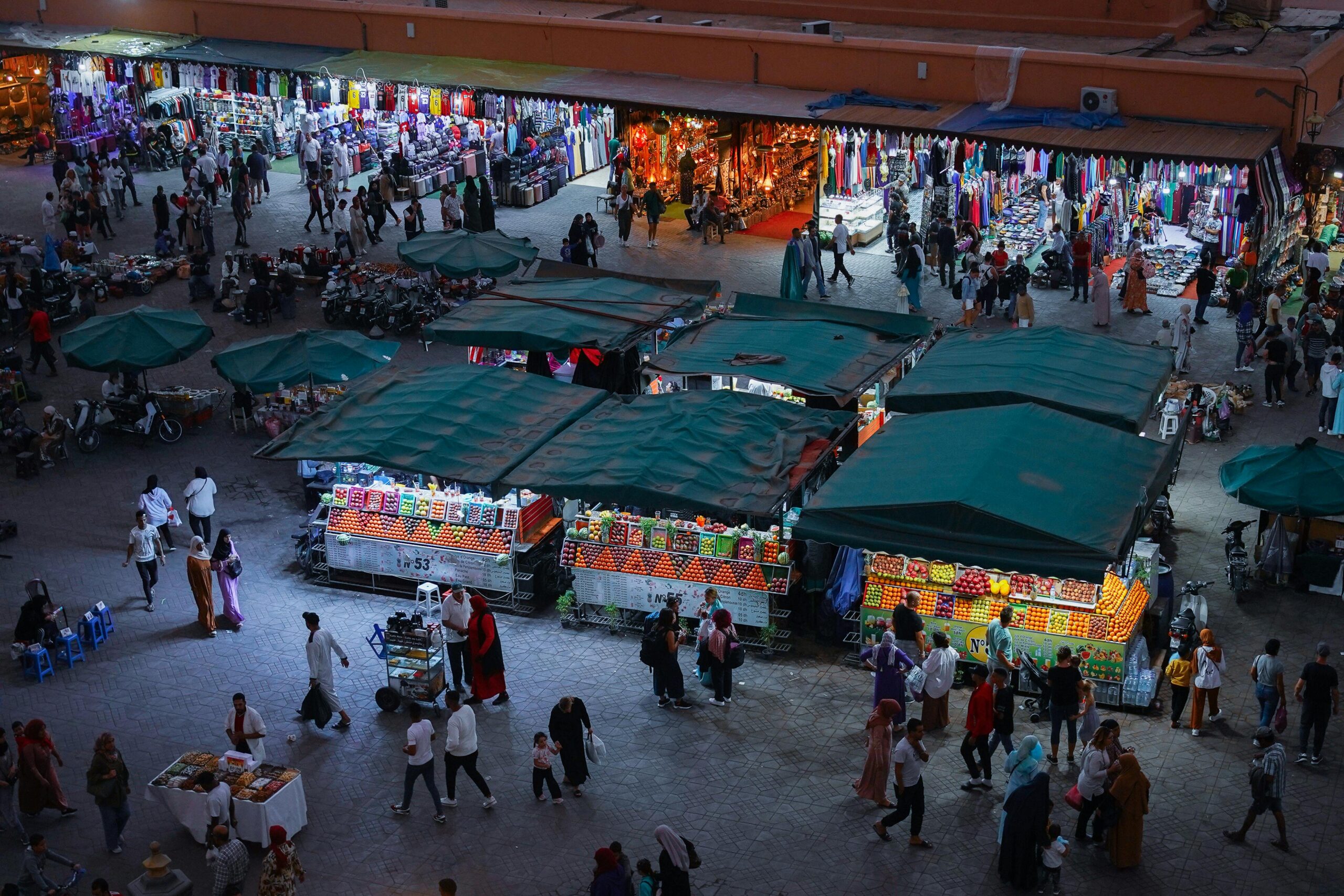
A hundred food stalls assemble in forty-five minutes after sunset. Walk to the middle, not the entrance — that's where prices stay fair.
Where the locals actually eat
The kitchens to seek — and the menus to skip.
Twenty years of meals across this country, distilled into two columns. Save the photo menus for the tourists and find the real plate next door.
Seek out
- Restaurants with no menu, only a daily chalkboard The cook decides what they're making that morning based on the market. The fewer the choices, the more likely it's hand-cooked. Saveur du Poisson in Tangier is the famous example — one set menu, daily.
- Family-home dining rooms ("maisons d'hôte" that serve dinner) Many riads quietly serve home-cooked dinners to guests if you ask 24 hours ahead. Pre-arranged, traditional, often by the riad's grandmother. The single best meal you'll have on the trip.
- Cafés with newspapers, no Wi-Fi sign A café full of older Moroccan men reading the paper is almost always the right café. The coffee is good, the bissara is bargain-priced, and you'll be left alone if you want to read.
- Stalls with the longest queue of Moroccans Always trust the longest local line, even if it looks chaotic. Fast turnover means fresh food. Slow turnover means yesterday's lamb.
- The 7am to 11am window Most Moroccan dishes are at their freshest before lunch. Tangia is just out of the embers, mechoui is just out of the pit, bread is just out of the communal oven.
- The cooperative cooking classes The all-women cooperatives (Berber Cooking Cooperative in Marrakech, Cafe Clock cooking school) end with you eating what you made. Best 350 MAD you'll spend on food culture.
Skip
- Restaurants with multilingual photo menus Every photo on a Moroccan menu is a warning sign. Photo menus indicate tourist pricing, frozen ingredients, and a kitchen running on autopilot. Locals don't need pictures.
- "Berber breakfast" tourist platters The 80–120 MAD "Berber breakfast" assembled for tourists — honey, msemen, baghrir, jam, olives — is usually shop-bought and not the real Berber morning. Real Berber breakfast is msemen + amlou + tea; that's it.
- Couscous on a Tuesday If a restaurant offers couscous on a non-Friday, it's either reheated, frozen, or being made specifically for the tourist trade. Wait for Friday.
- Pastilla on the dinner menu Pastilla takes 4+ hours to make properly. Any restaurant offering it at 9pm has been keeping it warm since lunch. Order at lunch only.
- Tagines reheated from a buffet A real tagine cooks for 90+ minutes in its own clay pot. Restaurants offering "tagine in 20 minutes" or serving it from a steam tray are doing something else. Smell the pot before ordering.
- Drinking the carafe water on a stall table The carafe water at Jemaa stalls is rarely filtered. Always ask for bottled (Sidi Ali or Oulmès); it's 6–8 MAD. The stalls are clean; the carafe water sometimes isn't.
Specific lived moments
Notes from the kitchens.
Small, specific, hard-won. The kind of detail only a Moroccan would notice.
— Izem
How to know if pastilla is fresh.
Look at the sugar dusting on top. Real pastilla has sugar in concentric circles or a tight diamond pattern — the cook dusts it through a stencil right before serving. Fake pastilla has straight lines or no pattern at all (sugar poured from a shaker). The same rule for cinnamon. If both the sugar and the cinnamon are in proper swirls, you've found a serious kitchen. If they look like they were sprinkled from a salt shaker, walk out.
— Asmoon
The Friday couscous protocol.
If invited to Moroccan family Friday lunch: arrive at 1:30pm, not 12:30pm (the polite Moroccan lunch hour). Bring a small gift — pastries from a known bakery, a kilo of dates, or fresh fruit. Wash hands at the door. Eat with right hand only, from the wedge of couscous nearest you (don't reach across). Don't ask "what's in this" mid-bite. Praise the cook directly, by name, before leaving: "Bnin bzaf, Lalla Fatima."
— Amghar
The 7am mechoui slang.
When you order mechoui at the Marrakech alley, you don't just say "a kilo". You order by part. "Katef" = shoulder (the most flavour, falls apart). "Fakhda" = leg (less fat, cleaner). "Reasse" = head (offered as a special; you'll see why if you're brave). Asking for "shoulder" in English will get you whatever's left from the night before. Asking for "katef bzaf" in Darija gets you the real cut. Two-word difference; full-meal difference.
— Izem
The amlou jar test.
Buying amlou to take home: open the jar in the shop and smell it. Real amlou smells deeply of roasted almonds and a faint nutty argan oil — not vegetable oil, not perfume. The colour should be deep honey-amber, slightly grainy in texture, with visible almond particles. Industrial versions are uniformly smooth, paler, often watery-looking. The 80 MAD jar at a women's cooperative in Ourika is worth ten of the 40 MAD jars in the airport.