
Traveller's guide · Cultural etiquette
11 min · The quiet rules · By Amghar
The quiet rules — and the warmth behind them.
Three glasses of tea, the right hand for bread, when to take photos and when not to. What tipping really means, how to say "no thank you" without breaking a smile.
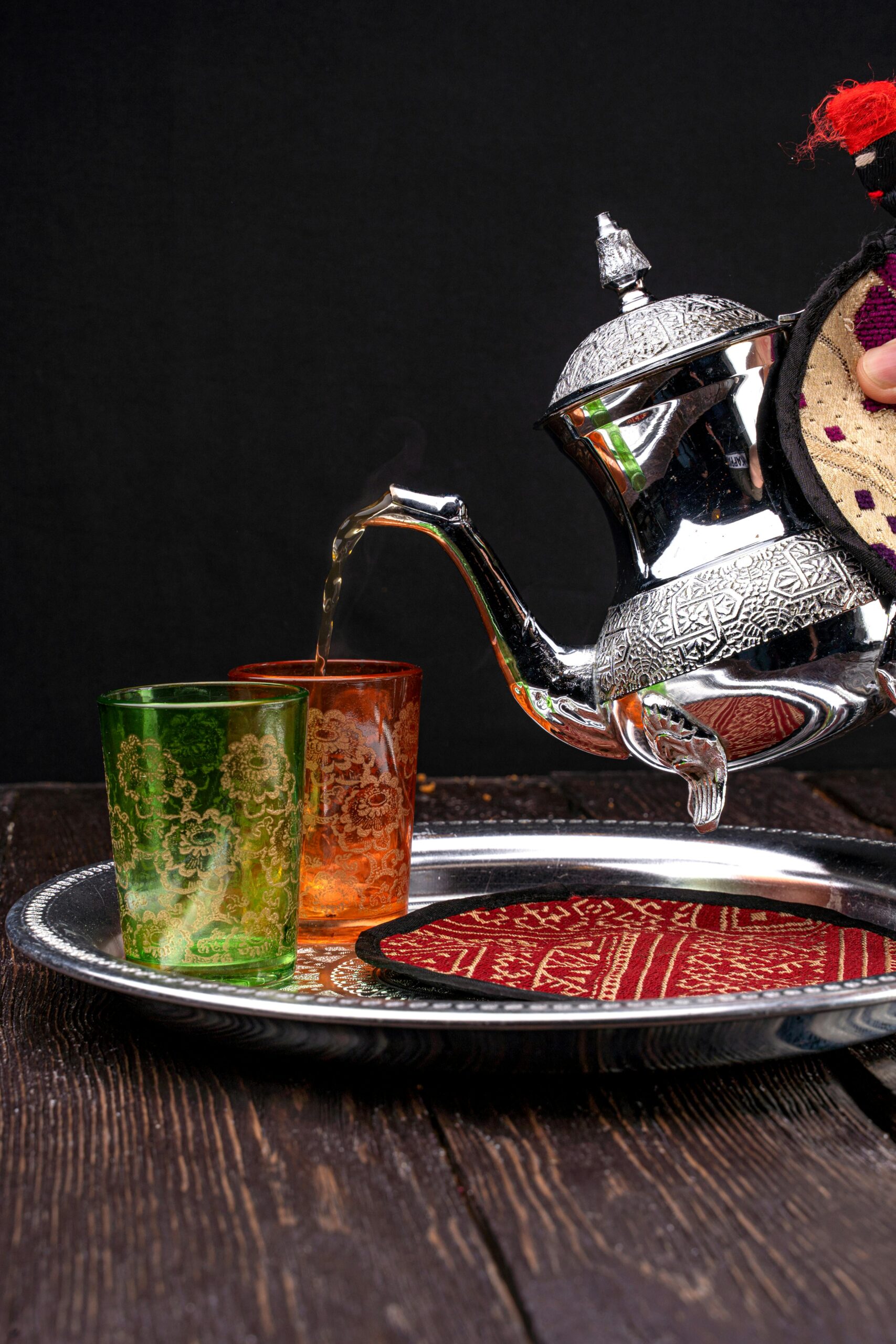
A note from Amghar. I grew up watching my grandmother pour tea from a height of two feet without spilling a drop. That was the first etiquette lesson she gave us, before any of us could speak full sentences.
Moroccan etiquette runs on hospitality, not formality. The rules look like restrictions from the outside — three teas, right hand only, no photos here, ask before that — but each one is actually a small kindness toward the person across from you. The right-hand rule means "I'm offering you my clean hand." The three-tea pour means "I'm not rushing you." The no-photo rule means "I see this person as a person, not a backdrop." Once you understand the warmth behind them, they stop being rules and start being instinct.
This guide is a walk through the five quiet rules every visitor should know — not as a checklist of dos and don'ts, but as a series of small ways to say "I see you" to the people you'll meet. Plus the things nobody writes down: the tip amounts in MAD for every kind of service, the four ways to say no without offending, the gestures that change a transaction. Read it before you fly. Apply it on day one. Watch the country open up.
The rules look like restrictions from the outside. From the inside, every one of them is a way of saying "I see you."Amghar · from the field
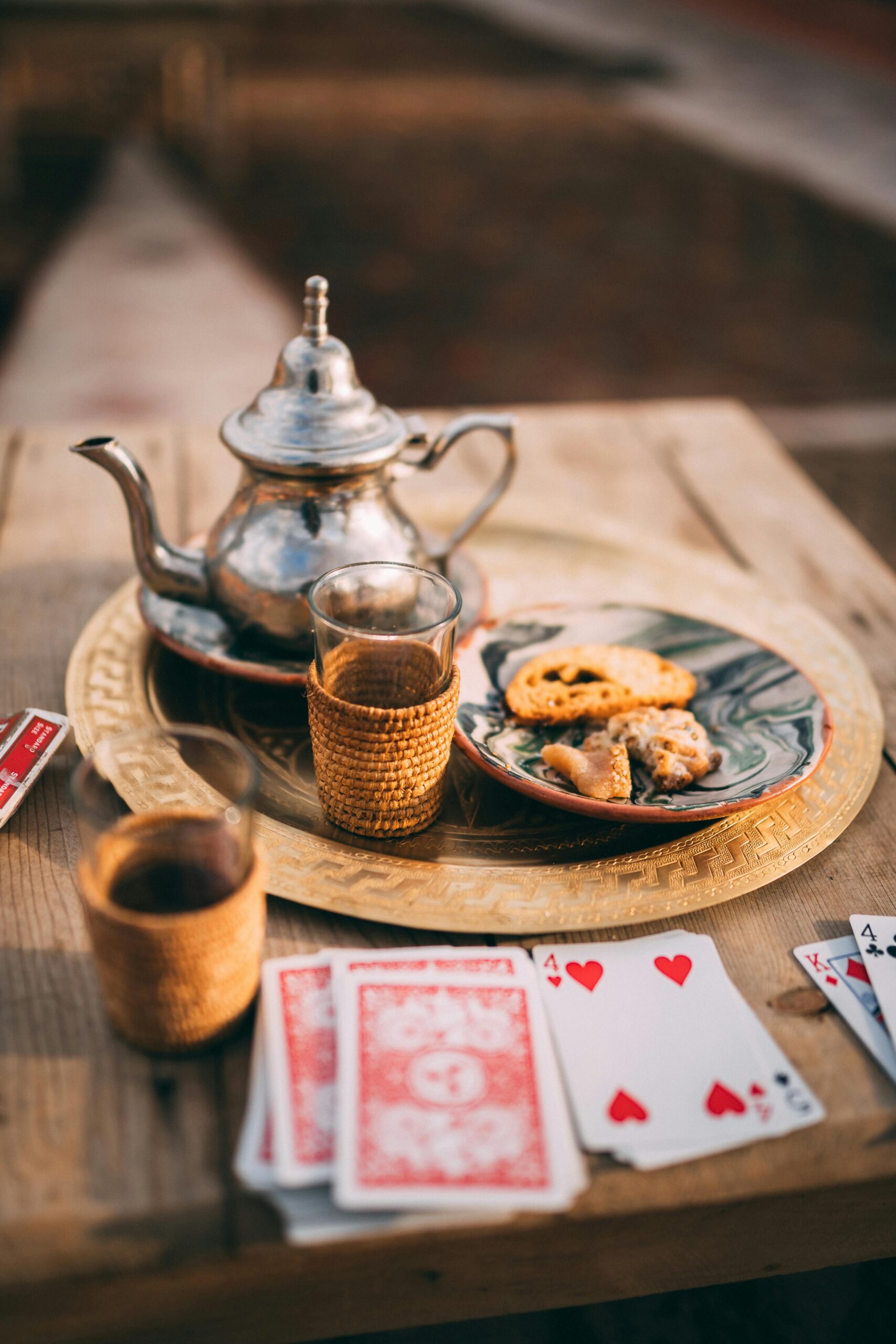
The same tea leaves are poured three times. Each glass tastes different. You drink all three.
The five quiet rules
What looks like a rule, read closely, is a kindness.
Five rituals every visitor should know — and the small acts of warmth that explain why each one exists. Take them slowly. They're meant to be felt, not memorised.
Rule 01 · The tea ritual
Three glasses of mint tea.
The same leaves brewed three times. The first glass is the strongest — bitter as life. The second is sweeter, infused longer — sweet as love. The third is mellow, almost transparent — gentle as death. The Tuareg saying is centuries old, and every Moroccan grandmother repeats it without irony. You drink all three. Leaving after one is read as "I have somewhere better to be."
Tea is poured from a height of 20–30 centimetres, creating the small foam (kashkasha) on top. The pour is itself a performance — both the height and the steadiness say "I'm not rushing." Sip your tea standing up only if leaving; sitting on a low stool, cross-legged on a rug, or on a riad rooftop signals you have time to give.
Rule 02 · The hand
The right hand for everything.
For eating bread, for breaking and sharing food from a common plate, for handing over money, for greeting. The left hand is reserved for the bathroom — and only for the bathroom. Even left-handed Moroccans eat with their right. It's not a religious obligation so much as a deeply-embedded cultural code: the right is the "clean" hand you offer the world.
In practice: tear bread with both hands but eat with the right, hand a 50 MAD note to a shopkeeper with your right, take change with your right, shake hands with your right. If you have to use both hands (carrying something, opening a door), use both — but if you only use one, make it the right.
Rule 03 · The lens
When to take photos — and when not to.
Photographing buildings, landscapes, markets, food: always fine. Photographing people requires a different protocol. Berber women almost universally don't want to be photographed. Tannery workers expect a small tip (5–10 MAD) for the iconic shot. Snake charmers and the Jemaa el-Fnaa performers expect 20 MAD. Children: ask their parents first, never directly.
The rule of thumb: if it's a portrait that includes a person's face clearly, ask. The phrase is "mumkin?" (may I?) accompanied by a small camera gesture. They will say yes or no. If yes, take one shot, show them, smile. If no, smile, lower the camera, walk on. Don't pretend to photograph something else; everyone sees it.
Rule 04 · The tip
What tipping really means.
Tipping in Morocco isn't an obligation — it's a small thank-you for genuine service. 10% in a sit-down restaurant if the service was good. Rounding up to the nearest 5 MAD in a taxi. 5–10 MAD for a small service: a porter, a hammam attendant for the entrance, a riad cleaner per day. More for someone who genuinely went out of their way — the hammam scrub-attendant who saved you the best marble slab, the riad host who arranged your taxi at 5am.
Don't over-tip — a 50 MAD tip on a 30 MAD coffee feels patronising. Don't under-tip either: a 1 MAD tip is worse than nothing (it reads as "I noticed your service was barely worth coins"). If unsure, hand the bill with a 5–10 MAD coin on top and say "khalik bih" ("keep it") with a small smile. The tip culture works on the small acts, not the big numbers.
Rule 05 · The refusal
How to say no — without breaking a smile.
A flat "no" reads as cold here. The Moroccan way is to refuse softly, with a smile, and a small gesture: right palm raised gently to chest, a slight nod of the head, and one of the polite phrases below. The smile is the entire message — without it, even "no thank you" comes across as rude.
The four phrases you can use in any setting — declining a shop offer, a marriage proposal joke, a free hashish in Chefchaouen, a third glass of tea you genuinely can't drink. Each ends a conversation gently, without giving offence:
Mashi mushkil
MA-shee moosh-KEEL
No problem / no worries
The universal soft refusal. Use for declining a shop, a guide, an offer.
La, shukran
LAH, SHOO-kran
No, thank you
The polite minimal refusal. Always with a smile and right-hand-to-heart.
Smahli, ma'andich
SMAH-lee, ma-an-DEESH
Sorry, I don't have / don't need
Excellent for declining money requests politely (without pretending you have nothing).
Sa'a o'khra, Inshallah
SA-ah okh-RAH, in-SHAH-lah
Another time, god willing
For declining invitations to homes, shops, "just one tea" offers. Leaves the door open warmly.
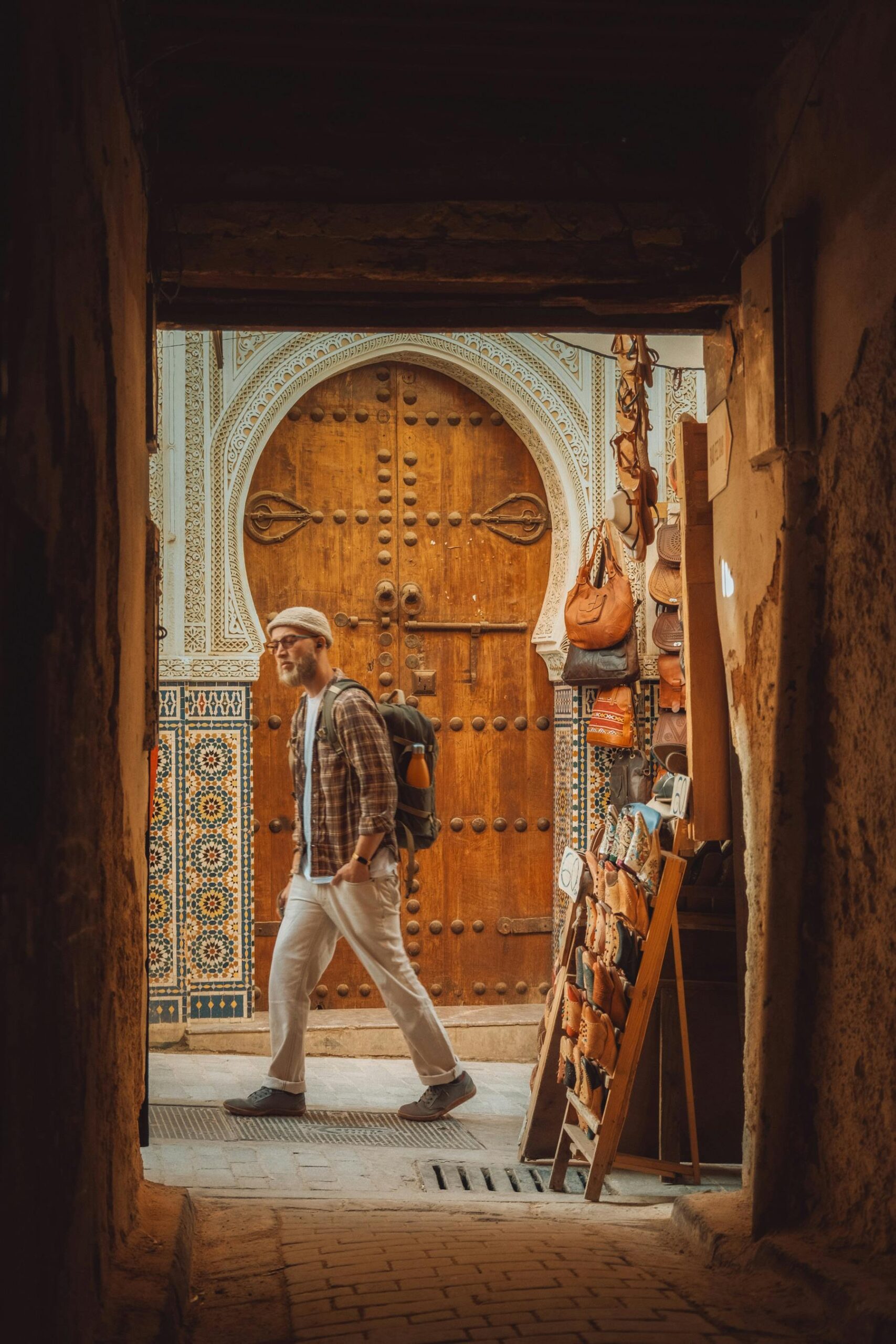
A 10 MAD coin on a small saucer is the universal "thank you, that mattered".
The tip amounts
What to leave, person by person.
The honest range for every kind of service in Morocco. Round up for genuine warmth; round down for transactional service. Either way, never a single dirham — that reads as an insult.
Sit-down restaurant
10% / 20 MAD
If service was good. Leave coins on the saucer, not the table.
Café (coffee / tea)
2–5 MAD
Round up to nearest 5. Standing-up coffee orders need no tip.
Petit taxi
5 MAD up
Round up to the nearest 5 MAD on metered fares.
Hammam attendant (full scrub)
30–50 MAD
Tip generously the first visit — you'll be protected on every return.
Hammam entrance only
5–10 MAD
If she helped you with a locker or towel.
Riad cleaner (per day)
10–20 MAD
Leave each morning on the pillow, not at the end of the stay.
Hotel porter (per bag)
10 MAD
Per bag, not per trip. Heavy luggage 20 MAD.
Half-day guide
100–200 MAD
Above the agreed fee. Full-day: 200–400 MAD additional.
Camel guide (Sahara)
50–100 MAD
Per person, end of the trek. They share among the team.
Photo of a craftsman / performer
10–20 MAD
Especially tanneries, snake charmers, water-sellers in Jemaa.
Things we learned the hard way
Notes from three generations.
Small, specific, lived. The kind of detail you only notice once someone shows you.
— Amghar
The "third refusal" rule.
Older Moroccans, especially Berber women, will refuse an offer twice before accepting on the third. It's a built-in dance of politeness. If you offer my grandmother a piece of fruit, she'll say "no, thank you". Offer again, she'll wave a hand. Offer a third time and she'll smile and take it — because three refusals would have been rude. Counterpart: if you say "no thanks" once to a Moroccan host, expect them to ask again at least twice. They're not being pushy. They're following the same script.
— Asmoon
The shoe-line at the doorway.
Entering any Moroccan home: look at the doorway. If shoes are lined up there, slip yours off too. Even if no one tells you to. The host won't insist — they'll just smile and gesture you in — but the small respect is noticed. The same rule applies in some rural restaurants (Atlas guesthouses, Berber tents) and in any room with rugs spread for sitting cross-legged.
— Izem
When to eat with cutlery.
Tourists are usually given cutlery in restaurants — but the right plate (couscous, tagine, mechoui) is meant to be eaten with bread and right hand. Eat with bread for the first ten minutes; if you struggle, then take the cutlery. The host will respect the effort. The reverse — reaching for the fork on the first bite — signals "I'm a foreigner who doesn't care." The small choice changes the warmth of the rest of the meal.
— Amghar
The greeting compounds.
A full Moroccan greeting is a small conversation. "Salam alaikum, labas? Kif halek? Hamdullah, kullshi mzyan? Bsahha." Five questions, five answers, all asked without expecting real responses. Don't try to actually answer each one in detail — respond with the same rhythm, "labas, hamdullah", hand to heart, smile. The greeting takes 15 seconds and is the entire social contract for the next exchange. Skip it and the exchange feels transactional.